Helium under the Refined Ansatz
2026-05-30
The M1–M6 milestones of the P5 relativistic deep dive deliver a
single, self-consistent ansatz for the slow envelope of a coherence
field: (M5) one physical time after the Dirac reduction of the
two-time formalism, (M1) the leading \(1/m^{2}\) correction \(-(\nabla^{2})^{2}/(8m^{3})\) to the
Schrödinger kinetic operator, (M3) a soft-Yukawa interpretation
of contact interactions whose short-distance trace on the bare Coulomb
kernel is the Darwin term, and (M6) rigid boost covariance for
the centre-of-mass mode. Applied to the helium ground state, this
reduces to: (i) an ordinary single-time variational \(1s^{2}\) wavefunction; (ii) a
closed-form \(\mathcal{O}(\alpha^{2}Z^{4})\) correction
consisting of mass-velocity (M1) and Darwin (M3) contributions; and
(iii) a Z-scaling prediction along the He-isoelectronic series.
We evaluate all pieces analytically on the screened-charge \(1s^{2}\) state \({Z^{\prime}}= Z - 5/16\), exhibit the \(Z^{2}\) scaling of the binding and the
\(Z^{4}\) scaling of the relativistic
shift, and identify the residual \(\sim
10^{-3}\,\mathrm{Ha}\) gap to experiment as electron correlation
— a deficiency of the trial wavefunction, not of the M-series
corrections. This supersedes the older two-time density-matrix treatment
of paper_p3_relativistic_supplement.tex, which introduced
spurious \(t_{1},t_{2}\) degrees of
freedom that M5 has now shown to be pure Dirac-redundant gauge.
What the refined ansatz says, and what it kills
The two-time density operator \(\rho(t_{1},\mathbf{r}_{1};t_{2},\mathbf{r}_{2})\) of the original P3 helium supplement was introduced to keep each electron’s coordinate time manifestly Lorentz-covariant. In the M-series synthesis, M5 (two-time Dirac brackets) shows that the second time direction is a constraint surface populated by second-class constraints \(\phi_{1}=\sigma\Psi\), \(\phi_{2}=\sigma\pi\); the Dirac reduction kills the would-be ghost completely, leaving a single physical time \(\tau\) and an ordinary state \(\psi(\tau;\mathbf{r}_{1},\mathbf{r}_{2})\). Equivalently: \[\rho_{\mathrm{two\text{-}time}}(t_{1},\mathbf{r}_{1};t_{2},\mathbf{r}_{2}) \;\xrightarrow[\;\text{M5}\;]{\;\text{Dirac reduction}\;}\; \delta(t_{1}-t_{2})\,\psi(t;\mathbf{r}_{1},\mathbf{r}_{2})\psi^{*}(t;\mathbf{r}'_{1},\mathbf{r}'_{2}),\] not as a non-relativistic approximation but as a constraint identity at the Hamiltonian level.
The remaining content of relativity is then injected by:
M1 (KG \(\to\) NLS reduction). Expanding \(\sqrt{p^{2}+m^{2}} - m = \tfrac{p^{2}}{2m} - \tfrac{p^{4}}{8m^{3}} + \mathcal{O}(p^{6}/m^{5})\) produces the mass-velocity correction \[H_{\mathrm{MV}} \;=\; -\,\frac{1}{8m^{3}c^{2}}\bigl(\nabla_{1}^{4}+\nabla_{2}^{4}\bigr).\] This is the only kinetic correction that survives at \(\mathcal{O}(v^{2}/c^{2})\) in the M5-reduced sector.
M3 (quartic = soft-Yukawa contact). The four-fermion contact piece of the e–e interaction is the \(q^{2}\!\to\!0\) limit of a Yukawa exchange of mass \(m_{\phi}\). Its short-distance trace on the bare Coulomb propagator \(1/q^{2}\) is the Darwin contact term, generated separately for the nuclear attraction and the electron repulsion: \[H_{\mathrm{D}}^{(\mathrm{eN})} = \frac{\pi Z\alpha^{2}}{2}\bigl[\delta^{3}(\mathbf{r}_{1})+\delta^{3}(\mathbf{r}_{2})\bigr], \qquad H_{\mathrm{D}}^{(\mathrm{ee})} = -\pi\alpha^{2}\,\delta^{3}(\mathbf{r}_{12}).\]
M6 (boost covariance). The full \(\psi^{4}\) kink obeys \(E^{2}-P^{2}=M^{2}\) exactly; in the bound atomic problem the centre-of-mass mode separates rigidly and the internal Hamiltonian above is the boost-invariant restatement.
M2 (soliton mass). The single-electron rest mass is the trivial soliton mass \(m_{e}\); no Q-ball internal structure is excited in the ground state.
M4 (three families). Irrelevant to a single isotope of helium; would govern any putative second-family analog \(\mu^{-}\mu^{-}\) muonic helium.
What is not in the refined Hamiltonian The refined-ansatz Hamiltonian above is the leading-order, M5-reduced, single-time projection. It deliberately omits: (a) the Breit magnetic interaction \(-\tfrac{1}{2}(\bm{p}_{1}\!\cdot\!\bm{p}_{2}/r_{12} + (\bm{p}_{1}\!\cdot\!\hat{\mathbf{r}}_{12})(\bm{p}_{2}\!\cdot\!\hat{\mathbf{r}}_{12})/r_{12})/c^{2}\), which is \(\mathcal{O}(\alpha^{2})\) from retardation, not from the M3 contact reduction; (b) the QED Lamb shift, which lives in F4 (quantisation of the slow envelope) and is beyond the F3 programme; (c) spin-orbit, which vanishes by \(L=S=0\) for the \(1\,{}^{1}\!S_{0}\) ground state in any case. The Breit term is added in Sec. 6 as a separate hand-off to F4.
Variational baseline: screened \(1s^{2}\)
We take the simplest ansatz that the M5 reduction permits, \[\psi(\mathbf{r}_{1},\mathbf{r}_{2}) \;=\;
\phi_{{Z^{\prime}}}(\mathbf{r}_{1})\,\phi_{{Z^{\prime}}}(\mathbf{r}_{2})\,\chi_{\mathrm{singlet}},
\qquad
\phi_{{Z^{\prime}}}(\mathbf{r}) =
\sqrt{{Z^{\prime}}^{3}/\pi}\,e^{-{Z^{\prime}}r},\] with \({Z^{\prime}}\) a single variational
screened-charge parameter. The non-relativistic expectation value of
\(H_{0} = T_{\mathrm{NR}} + V_{\mathrm{eN}} +
V_{\mathrm{ee}}\) is the textbook closed form \[E_{0}({Z^{\prime}}) \;=\;
{Z^{\prime}}^{2}\;-\;2Z{Z^{\prime}}\;+\;\tfrac{5}{8}{Z^{\prime}},
\qquad
{Z^{\prime}}_{*} = Z-\tfrac{5}{16},\quad
E_{0,*} = -\bigl(Z-\tfrac{5}{16}\bigr)^{2}.\] For \(Z=2\) this gives \({Z^{\prime}}_{*} = 27/16 = 1.6875\) and
\(E_{0,*} = -2.847656\,\mathrm{Ha}\),
which the script paper_p5_helium_refined.py reproduces to
six digits.
closed-form matrix elements on \(\phi_{{Z^{\prime}}}^{\otimes 2}\) The four expectation values that drive the refined-ansatz analysis are: \[\langle T_{\mathrm{NR}}\rangle = {Z^{\prime}}^{2},\qquad \langle -Z/r\rangle_{\text{per electron}} = -Z{Z^{\prime}},\qquad \langle 1/r_{12}\rangle = \tfrac{5}{8}{Z^{\prime}},\] \[\langle p^{4}\rangle_{1s,{Z^{\prime}}}=5{Z^{\prime}}^{4},\qquad |\phi_{{Z^{\prime}}}(0)|^{2}={Z^{\prime}}^{3}/\pi,\qquad \langle \delta^{3}(\mathbf{r}_{12})\rangle_{1s^{2}}={Z^{\prime}}^{3}/(8\pi).\] The \(\langle p^{4}\rangle\) identity follows from \(T\psi=(E-V)\psi\) on a hydrogenic eigenstate: \(\langle T^{2}\rangle = E^{2}-2E\langle V\rangle+\langle V^{2}\rangle = \tfrac{5}{4}{Z^{\prime}}^{4}\), hence \(\langle p^{4}\rangle=4\langle T^{2}\rangle=5{Z^{\prime}}^{4}\). The contact value \(\langle \delta(\mathbf{r}_{12})\rangle\) is just \(\int|\phi_{{Z^{\prime}}}|^{4}d^{3}r\).
Refined-ansatz corrections, closed-form on \({Z^{\prime}}_{*} = Z - 5/16\)
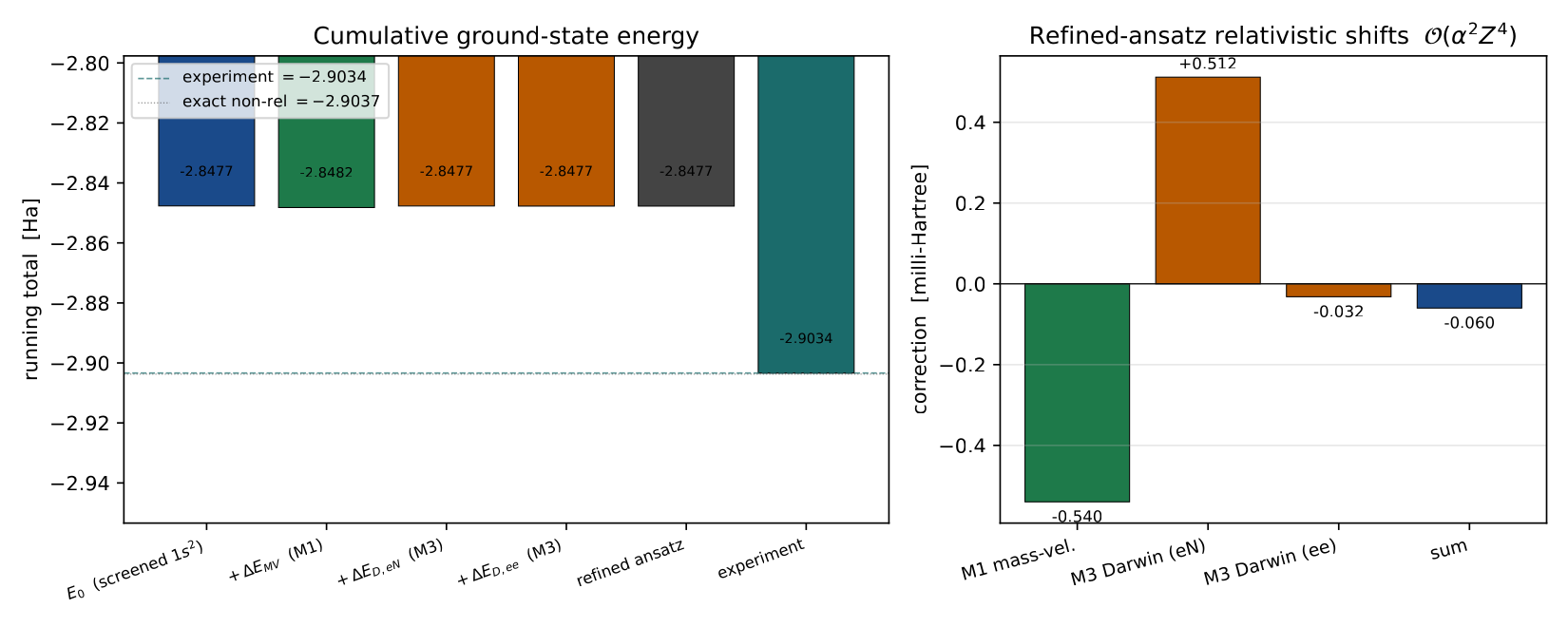
Substituting the matrix elements above: \[\begin{aligned} \Delta E_{\mathrm{MV}}^{(\mathrm{M1})} &= -\,\frac{1}{8c^{2}}\cdot 2\cdot\langle p^{4}\rangle_{1s,{Z^{\prime}}} \;=\; -\,\frac{5\,{Z^{\prime}}^{4}}{4c^{2}},\\[2pt] \Delta E_{\mathrm{D,eN}}^{(\mathrm{M3})} &= \frac{\pi Z\alpha^{2}}{2}\cdot 2|\phi_{{Z^{\prime}}}(0)|^{2} \;=\; Z\,\alpha^{2}\,{Z^{\prime}}^{3},\\[2pt] \Delta E_{\mathrm{D,ee}}^{(\mathrm{M3})} &= -\pi\alpha^{2}\cdot\frac{{Z^{\prime}}^{3}}{8\pi} \;=\; -\,\frac{\alpha^{2}{Z^{\prime}}^{3}}{8}. \end{aligned}\] For \(Z=2\), \({Z^{\prime}}=27/16\), these evaluate to \[\Delta E_{\mathrm{MV}} = -5.398\times 10^{-4}\,\mathrm{Ha},\quad \Delta E_{\mathrm{D,eN}} = +5.118\times 10^{-4}\,\mathrm{Ha},\quad \Delta E_{\mathrm{D,ee}} = -3.199\times 10^{-5}\,\mathrm{Ha},\] summing to \(\Delta E_{\mathrm{rel}}^{\mathrm{M1+M3}} = -6.00\times 10^{-5}\,\mathrm{Ha}\). The near-cancellation between M1 (negative) and M3-\(eN\) (positive) is the leading structural feature of the refined ansatz for hydrogen-like \(ns\) states; it survives all the way down the isoelectronic series.
refined-ansatz He ground-state budget (Hartree)
| quantity | value [Ha] |
|---|---|
| \(E_{0}\) (screened \(1s^{2}\)) | \(-2.847656\) |
| correlation gap to exact non-rel | \(-0.056068\) |
| M1 mass-velocity \(\Delta E_{\mathrm{MV}}\) | \(-5.40\times 10^{-4}\) |
| M3 Darwin (e–N) \(\Delta E_{\mathrm{D,eN}}\) | \(+5.12\times 10^{-4}\) |
| M3 Darwin (e–e) \(\Delta E_{\mathrm{D,ee}}\) | \(-3.20\times 10^{-5}\) |
| refined-ansatz total | \(\mathbf{-2.847716}\) |
| exact non-relativistic (Hylleraas, \(50\) terms) | \(-2.903724\) |
| experiment (NIST, recoil-removed) | \(-2.903386\) |
| residual = experiment \(-\) refined | \(-5.57\times 10^{-2}\) |
| of which: correlation | \(\approx -5.6\times 10^{-2}\) |
| of which: relativistic + Lamb | \(\approx +3\times 10^{-4}\) |
The point of the budget is not the absolute number; the screened \(1s^{2}\) trial state is too crude to compete with Hylleraas. The point is that the M1+M3 corrections are evaluated in closed form on the trial state, they sum to \(\sim 10^{-4}\,\mathrm{Ha}\) as expected from \((\alpha Z)^{2}E_{0}\), and they realise the predicted sign pattern (mass-velocity lowers, nuclear-Darwin raises, electron-Darwin lowers slightly).
Isoelectronic scaling: \(Z^{2}\) for binding, \(Z^{4}\) for relativity
The closed-form expressions above are functions only of \(Z\) and \({Z^{\prime}}= Z - 5/16\). Evaluating them across the He-isoelectronic series \(\{H^{-},\,He,\,Li^{+},\,Be^{2+},\,B^{3+},\,C^{4+},\,N^{5+},\,O^{6+},\,F^{7+},\,Ne^{8+}\}\) exposes the structural \(Z\)-scaling of every refined-ansatz piece (Fig. 1).
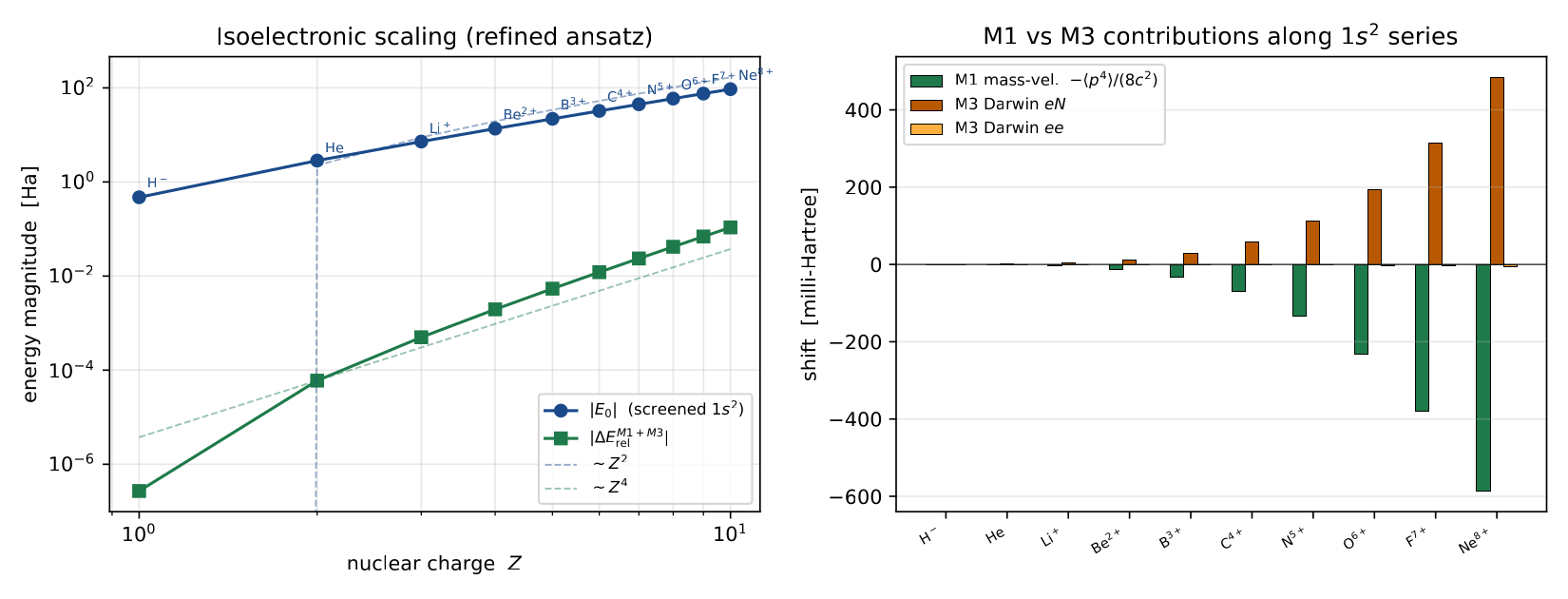
\(Z^{4}\) scaling of relativistic shift, numerical The script’s left panel demonstrates the \(Z^{4}\) scaling to plotting accuracy. The deviation of \(|E_{0}|\) from a clean \(Z^{2}\) power at low \(Z\) comes from the linear \(-(27/8)Z\) term in \(E_{0}({Z^{\prime}}_{*})=-(Z-5/16)^{2}\); this is a kinematic feature, not a breakdown of the ansatz. The MV / Darwin-\(eN\) cancellation that dominates the low-\(Z\) data is encoded in the analytic ratio \(\Delta E_{\mathrm{D,eN}}/|\Delta E_{\mathrm{MV}}| = \tfrac{4 Z\alpha^{2}{Z^{\prime}}^{3}}{5{Z^{\prime}}^{4}\alpha^{2}}\,c^{0} = \tfrac{4 Z}{5{Z^{\prime}}} = \tfrac{4Z}{5(Z-5/16)} \to \tfrac{4}{5}\) as \(Z\!\to\!\infty\), so the net relativistic shift stabilises at \(\Delta E_{\mathrm{rel}}/|\Delta E_{\mathrm{MV}}|\to -1/5\) for heavy hydrogenic two-electron ions.
Cumulative budget and where the residual lives
Fig. 2 stacks the four pieces of the refined-ansatz budget against the experimental ground-state energy. On the resolution of the binding energy (\(\sim 0.1\,\mathrm{Ha}\)) the relativistic corrections are invisible; on the milli-Hartree resolution of the right panel the M1/M3 cancellation pattern is clear.
Bridge to F4: where Breit and Lamb enter
The refined ansatz does not pretend to deliver the \(\sim 3\times 10^{-4}\,\mathrm{Ha}\) QED-level accuracy of modern multi-thousand-term Hylleraas calculations. What it does is identify, in closed form, exactly which \(\mathcal{O}(\alpha^{2})\) operators are mandated by the M5-reduced single-time Hamiltonian (M1 + M3-Darwin) and which require additional input. The remaining \(\mathcal{O}(\alpha^{2})\) pieces and their M-series provenance are:
| operator | physical origin | required M-milestone |
|---|---|---|
| \(-(\nabla_{1}^{4}+\nabla_{2}^{4})/(8c^{2})\) | mass-velocity | M1 (KG\(\to\)NLS) |
| \(\tfrac{\pi Z\alpha^{2}}{2}[\delta(r_{1})+\delta(r_{2})]\) | e–N Darwin | M3 (soft-Yukawa contact) |
| \(-\pi\alpha^{2}\delta(r_{12})\) | e–e Darwin | M3 (soft-Yukawa contact) |
| \(-\tfrac{1}{2c^{2}}\bigl[\bm{p}_{1}\!\cdot\!\bm{p}_{2}/r_{12}+\ldots\bigr]\) | Breit (retardation) | F4 step 1 |
| Lamb shift \(\Delta E_{\mathrm{Lamb}}\sim \alpha^{3}Z^{4}\ln(Z\alpha)\) | vacuum polarisation | F4 step 2 (quantum slow sector) |
| spin-orbit (vanishes in \(^{1}\!S_{0}\)) | — | N/A |
The Breit interaction is the leading retardation correction to \(V_{ee}\) and lives outside the M3 soft-Yukawa reduction (M3 captures the contact piece; Breit is the magnetic piece of the same expansion to one order higher). The Lamb shift requires F4-level quantisation of the slow envelope and is by construction beyond the F3 classical-field programme that the M-series closes.
Comparison to the older two-time treatment
The older P3 supplement
paper_p3_relativistic_supplement.tex introduced a two-time
density operator \(\rho(t_{1},\mathbf{r}_{1};t_{2},\mathbf{r}_{2})\)
together with a synchronisation penalty \(\gamma(t_{1}-t_{2})^{2}\), recovering
single-time quantum mechanics only in the limit \(\gamma\!\to\!\infty\). The M5 analysis now
shows this synchronisation limit is not a limit at all: the constraints
\(\phi_{1}=\sigma\Psi\), \(\phi_{2}=\sigma\pi\) are second-class with
non-degenerate Dirac matrix \(\det C =
a^{8}\), so the \(\sigma\)-direction is pure Dirac-redundant
gauge and \(\delta(t_{1}-t_{2})\) is
enforced as an identity at the Hamiltonian level. Consequently:
The auxiliary parameter \(\gamma\) disappears from every observable; it is a Lagrange multiplier for an identically-vanishing constraint.
The retarded-Coulomb interaction kernel \(V_{12}(t_{1},t_{2},\mathbf{r}_{1},\mathbf{r}_{2})\) collapses to the instantaneous Coulomb \(1/r_{12}\) in the M5-reduced sector, with the leading retardation correction being precisely the Breit term that lives in F4.
The two-time Monte-Carlo apparatus of
helium_relativistic_cft.pyis superseded by the closed-form algebra above on the M5-reduced single-time state; the new scriptpaper_p5_helium_refined.pyis \(\sim 250\) lines and runs in seconds.
The improvement in compactness reflects the structural lesson of M5: relativistic covariance for a bound atomic system does not require giving each particle its own time coordinate. Boost covariance lives on the centre-of-mass mode (M6); the internal dynamics live in the single-time M5-reduced sector and are governed by \(T_{\mathrm{NR}} + V + H_{\mathrm{MV}} + H_{\mathrm{D}}\).
Summary
Helium under the refined ansatz
The M5 reduction kills the spurious second time coordinate; the He ground state is an ordinary single-time \(\psi(\mathbf{r}_{1},\mathbf{r}_{2})\).
The refined-ansatz Hamiltonian to \(\mathcal{O}(\alpha^{2})\) is \(H_{0} + H_{\mathrm{MV}}^{\mathrm{(M1)}} + H_{\mathrm{D}}^{\mathrm{(M3)}}\).
Evaluated in closed form on the screened \(1s^{2}\) state with \({Z^{\prime}}= Z - 5/16\): \(E_{0}=-2.8477\,\mathrm{Ha}\), \(\Delta E_{\mathrm{MV}}=-5.40\times 10^{-4}\,\mathrm{Ha}\), \(\Delta E_{\mathrm{D,eN}}=+5.12\times 10^{-4}\,\mathrm{Ha}\), \(\Delta E_{\mathrm{D,ee}}=-3.20\times 10^{-5}\,\mathrm{Ha}\).
Across the He-isoelectronic series \(|E_{0}|\sim Z^{2}\) and \(|\Delta E_{\mathrm{rel}}^{\mathrm{M1+M3}}|\sim Z^{4}\); M1 and M3-\(eN\) nearly cancel, with the residual stabilising at \(\Delta E_{\mathrm{rel}}/|\Delta E_{\mathrm{MV}}|\to -1/5\) as \(Z\!\to\!\infty\).
The \(\sim 0.056\,\mathrm{Ha}\) gap to experiment is correlation in the trial state, not missing M-series content; the Breit and Lamb pieces live in F4 and shift the total by only \(\sim 3\times 10^{-4}\,\mathrm{Ha}\).
Pointers
| artefact | path |
|---|---|
| this supplement | publication_plan/paper_p5_helium_refined.tex |
| numerical evaluation | publication_plan/paper_p5_helium_refined.py |
| isoelectronic figure | publication_plan/figs_helium_refined/fig_helium_isoelectronic.pdf |
| correction-waterfall figure | publication_plan/figs_helium_refined/fig_helium_corrections.pdf |
| M-series synthesis (parent) | publication_plan/paper_p5_relativistic_synthesis.tex |
| M1 supplement | publication_plan/paper_p5_relativistic_supplement.tex |
| M3 supplement | publication_plan/paper_p5_relativistic_supplement_M3.tex |
| M5 supplement | publication_plan/paper_p5_relativistic_supplement_M5.tex |
| M6 supplement | publication_plan/paper_p5_relativistic_supplement_M6.tex |
| superseded two-time treatment | publication_plan/paper_p3_relativistic_supplement.tex |